

In our previous article, ‘Hands on with the Threadripper™ 9000 series’, we conducted a series of benchmarking tests on the new Threadripper™ PRO 9975WX, citing its incredible performance in multi-core applications and the massive performance advantage you’ll see in multi-threaded creative applications compared to high-end commercial CPUs and previous generation workstation processors. What we were really keen to see however, was how the improvements to the new 9975WX compared to the previous generation 7000 series CPUs, in real-world and synthetic workloads. In this article, we’re comparing the Threadripper™ 9975WX to the 7970X. If you’re a studio weighing whether to invest in the 9000 series, this comparison shows where you’ll see meaningful returns.
Specifications comparison
Before we get into the testing, here is how the 9975WX and 7970X compare on paper:
| PRO 9975WX | 7970X | |
|---|---|---|
| Cores | 32 | 32 |
| Threads | 64 | 64 |
| Base Clock | 4.0 GHz | 4.0 GHz |
| Max Boost | 5.4 GHz | 5.3 GHz |
| L1 Cache | 2560 KB | 2048 KB |
| L2 Cache | 32 MB | 32 MB |
| L3 Cache | 128 MB | 128 MB |
| Memory Channels | 8 | 4 |
| PCIe 5.0 Lanes | 128 | 48 |
| TDP | 350W | 350W |
| Fastest supported memory | Up to 6400 MT/s | Up to 5200 MT/s |
At first glance, the 9975WX and 7970X share the same core and thread count (32 cores / 64 threads), identical base clocks (4.0 GHz), and similar cache configurations (32 MB L2, 128 MB L3). This means that single-threaded performance gains are expected to be modest.
Where the 9975WX offers an advantage
The 9975WX, however, edges ahead with a slightly higher max boost clock (5.4 GHz vs 5.3 GHz), which should deliver minor improvements in lightly threaded workloads. The most significant upgrades lie in platform-level features:
- PCIe 5.0 lanes: 9975WX offers 128 lanes compared to 48 on the 7970X, dramatically increasing bandwidth for multi-GPU setups, high-speed storage, and I/O-heavy professional workloads.
- Memory channels: Both CPUs support 8-channel memory, maintaining excellent memory bandwidth for large datasets, but the improved platform on the 9975WX may allow for faster RAM support depending on the motherboard.
- Power envelope: Both CPUs sit at 350 W TDP, so efficiency gains are largely realized through improved boost behavior and platform optimizations rather than lower power draw.
Benchmarking methodology
Our initial testing of the 9975WX was carried out on the following test rig:
CPU: AMD Ryzen 9975WX 32-Core 64-Thread CPU
Motherboard: ASUS Pro WS WRX90E-SAGE SE Threadripper™ Motherboard
Memory: 64GB Micron DDR5 RDIMM 4800MHz CL40 (4x16GB)
Cooler: be quiet! Silent Loop 3 420mm Processor All-in-one liquid cooler
GPU: MSI GeForce RTX 1050 Ti 4GT LP
For testing the 7970X, we kept the test rig as like-for-like as possible, though we did have to swap out the WRX90 motherboard for an Asus PRO WS TRX50-SAGE WIFI motherboard, which was unavoidable given the chipset limitations, but all other major components remained the same.
As with our previous test, we ran the 7970X through ten repeated tests in Blender, Cinebench 24, V-Ray, Passmark, Geekbench 6, and a speed test to compile the Unreal Engine 5 source code and took an average result from across the tests. We monitored the ambient temperature to ensure the environment was the same, beginning each test from the same ambient temperature.
Blender performance
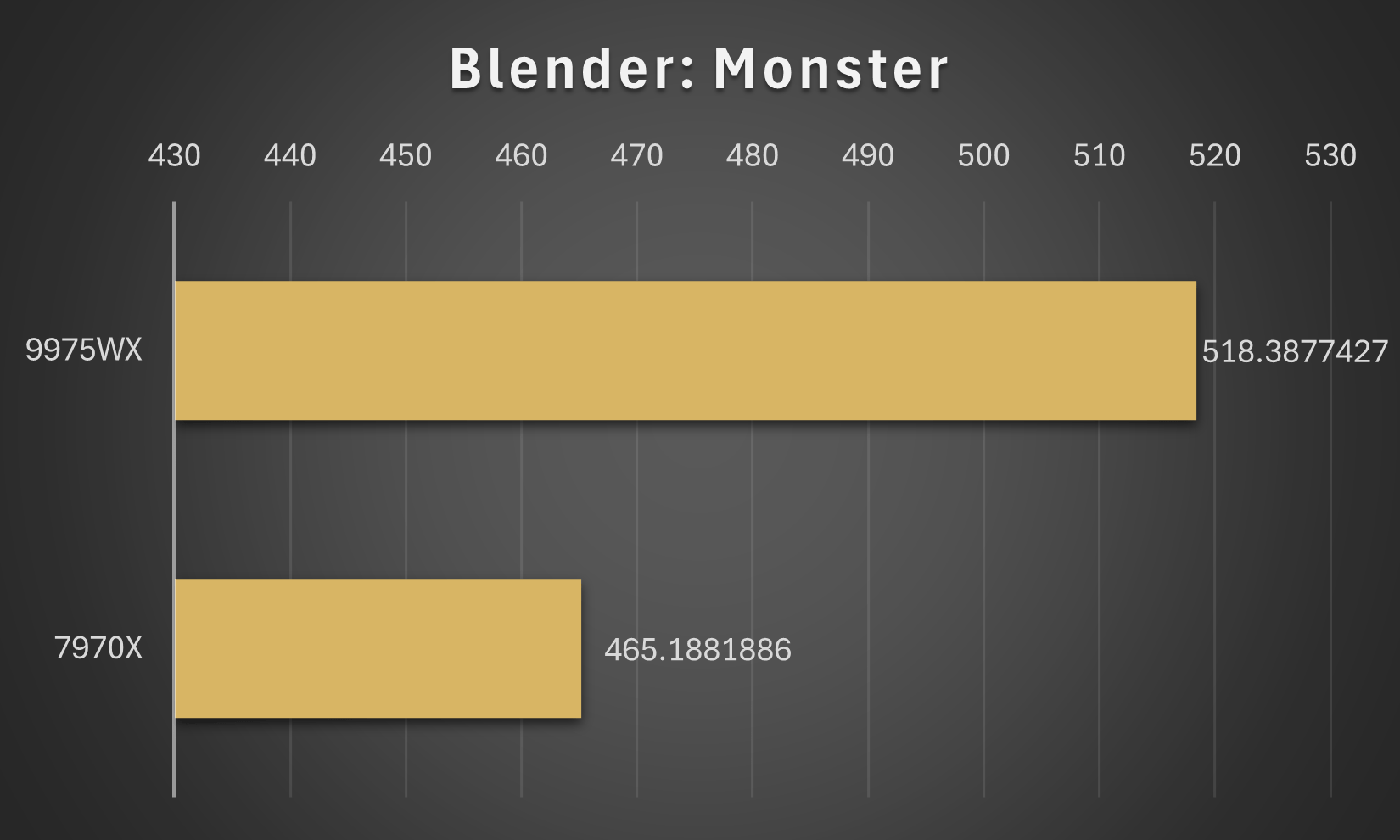
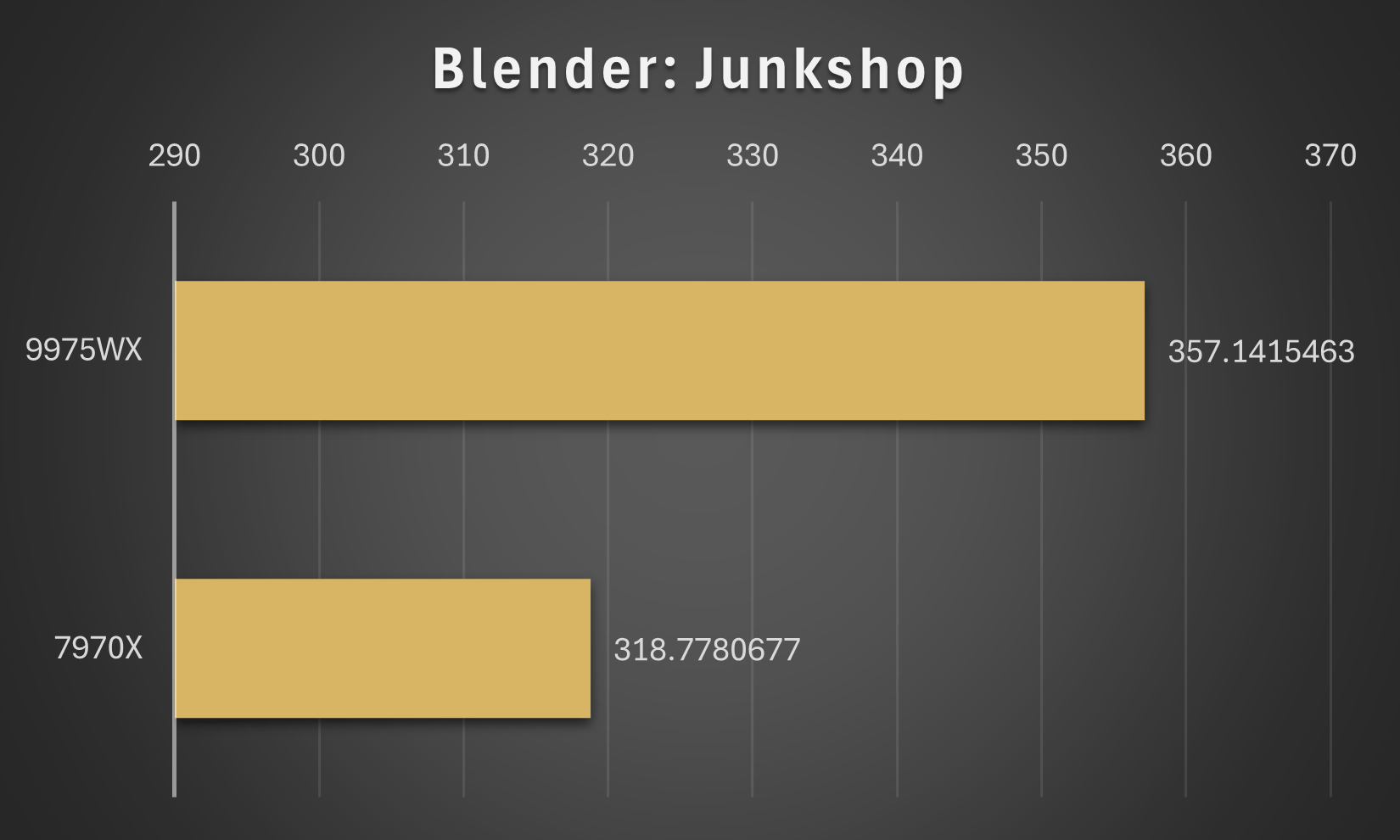
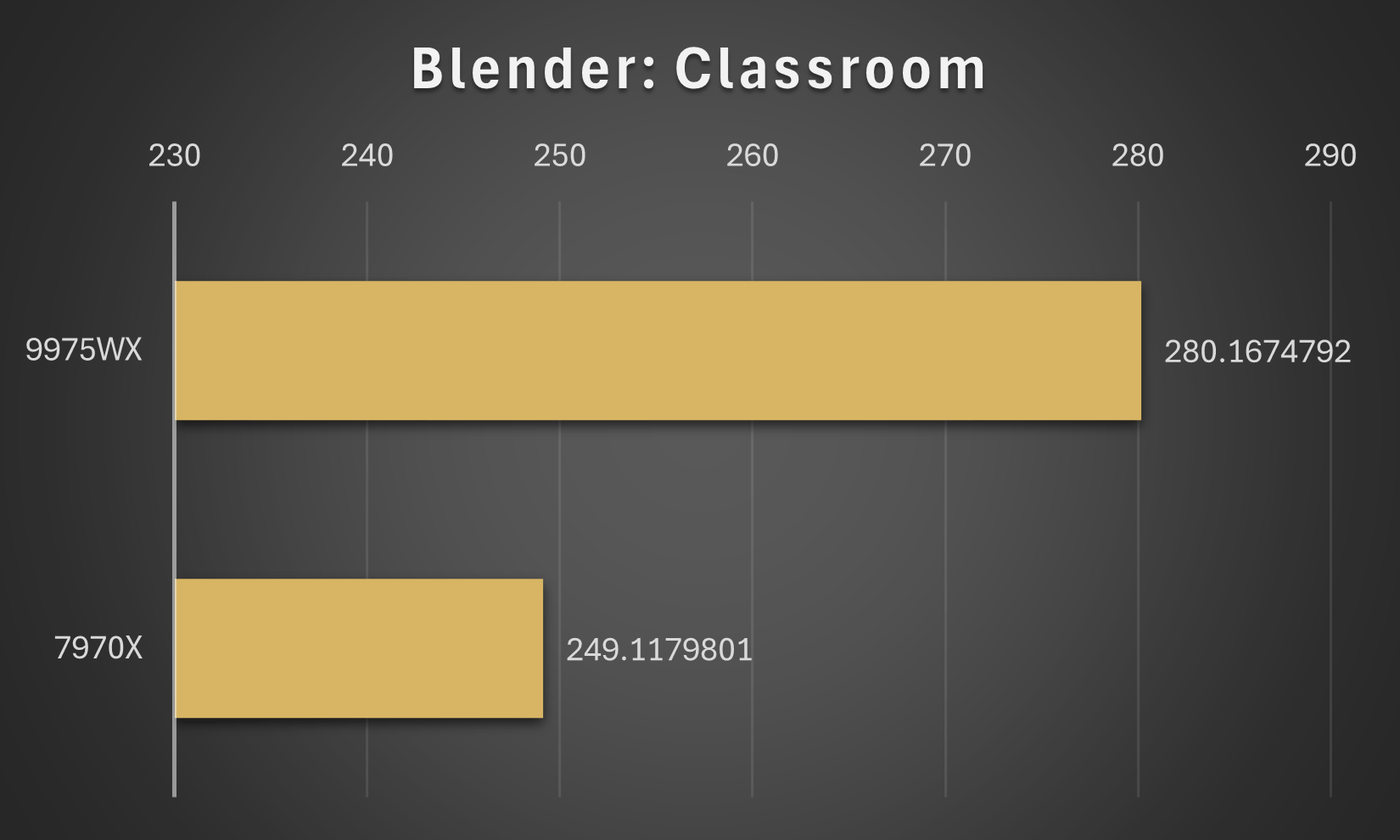
When it comes to complex animations, high resolution stills, fast render times and challenging visual effects, the 9975WX brings a significant step forward in what you can achieve, offering a 10.82% improvement in Monster, an 11.35% improvement in Junkshop and an 11.73% improvement in Classroom.
In practical terms, these gains mean that scenes which previously took hours to render on the 7970X can now be completed noticeably faster, freeing up more time for iteration, experimentation, and refinement. For artists and studios, this translates into a smoother workflow, shorter deadlines, and the ability to tackle more complex projects without compromising quality. Whether it’s refining intricate details in high-resolution stills, animating multiple characters simultaneously, or applying sophisticated visual effects, the 9975WX reduces bottlenecks, allowing creators to focus more on creativity rather than waiting on rendering.
Cinebench 2024
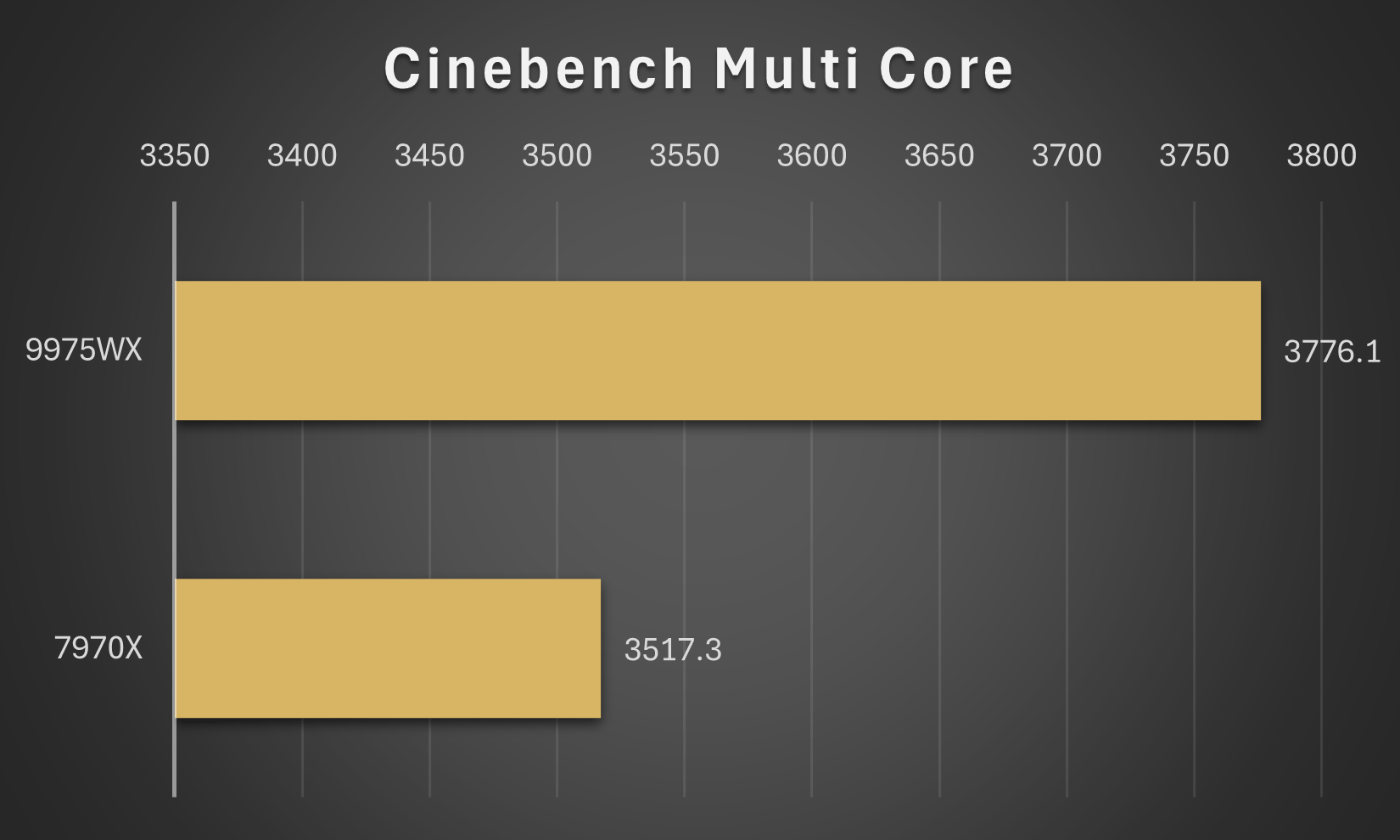
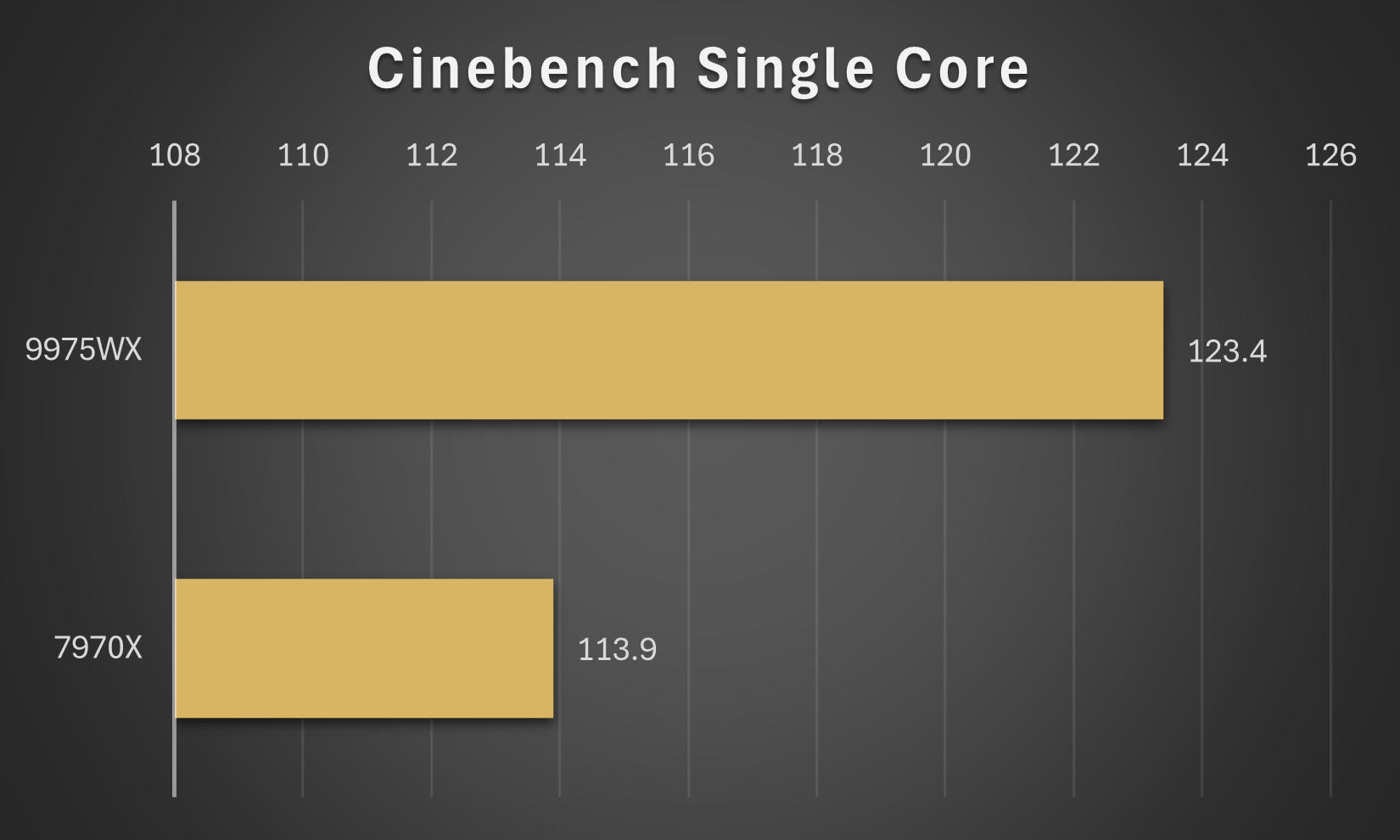
A 7.10% increase in Cinebench multi-core performance indicates that the 9975WX offers a modest but meaningful improvement in heavily multi-threaded workloads. For professionals running CPU-intensive applications such as 3D rendering, simulations, or large-scale data processing, this can translate into slightly faster project completion times and smoother handling of complex tasks. While the difference isn’t revolutionary, it provides a tangible efficiency gain for users who regularly push all cores to their limits, making the 9975WX a sensible upgrade for those seeking incremental improvements in throughput without changing their workflow.
V-Ray
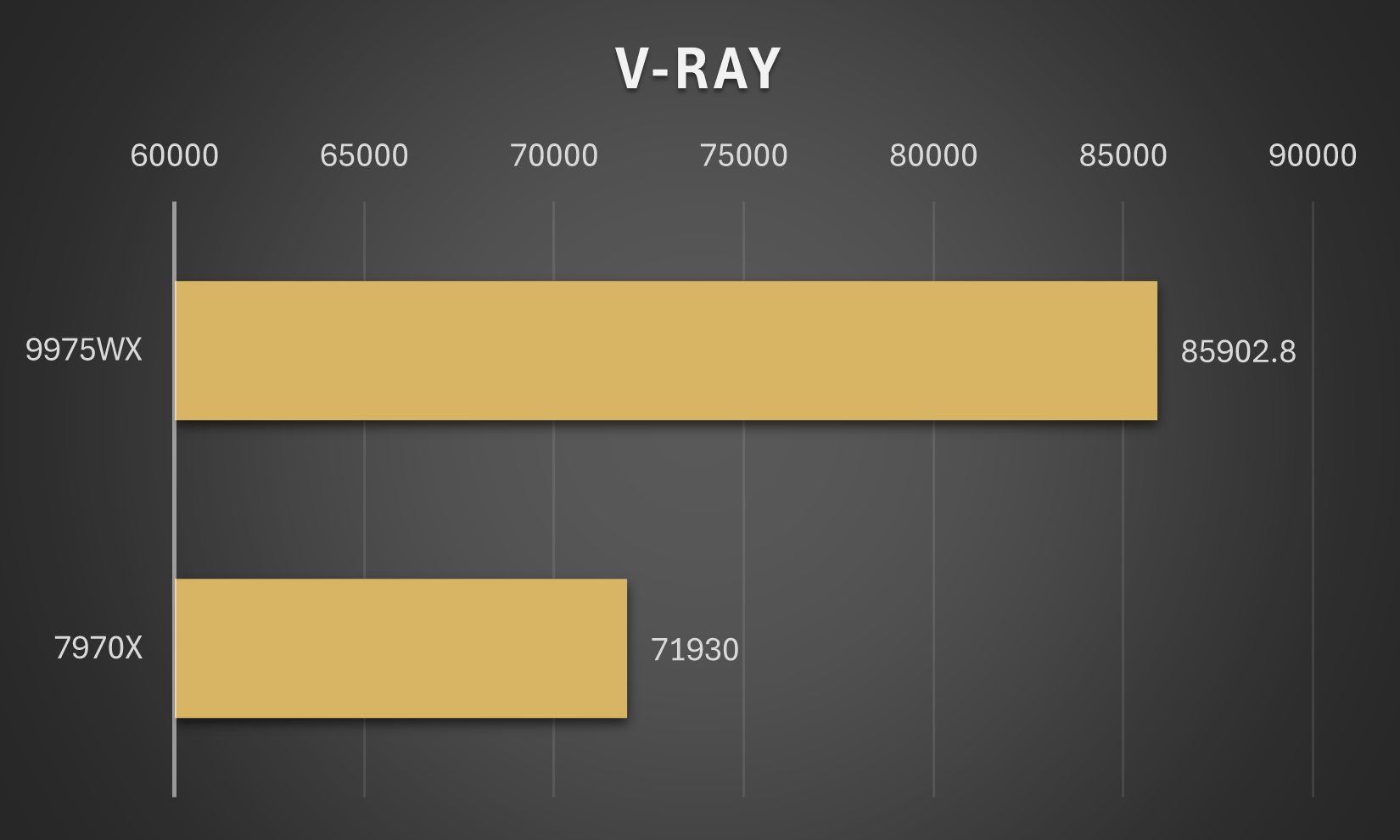
A 17.71% improvement in V-Ray performance means that renders that previously took an hour on the 7970X could now be completed in roughly 50 minutes on the 9975WX. For end users, this is a meaningful time saving, especially on larger, more complex scenes or batch renders. Over the course of a day or a full project, these gains add up, allowing artists, architects, and visualization professionals to iterate more quickly, meet deadlines with greater ease, and take on more ambitious workloads without increasing hardware. It’s the kind of improvement that directly enhances productivity rather than just benchmark scores.
Passmark

A 5.52% increase in PassMark CPU Mark is relatively modest, and for many everyday workloads it may not feel like a dramatic difference. For general-purpose computing, office applications, or even lightly threaded creative tasks, users are unlikely to notice much change. However, it still reflects a small overall efficiency gain across a broad spectrum of CPU operations. In practice, this means the 9975WX won’t feel “revolutionary” for all-around tasks, but for specialized, highly threaded applications (especially those like rendering or simulation where every percentage counts) it still contributes to a measurable improvement in throughput. Essentially, this is a refinement rather than a game-changing leap, and highlights that the main advantages of the 9975WX lie in platform enhancements and workloads that can fully utilize all cores.
Geekbench 6
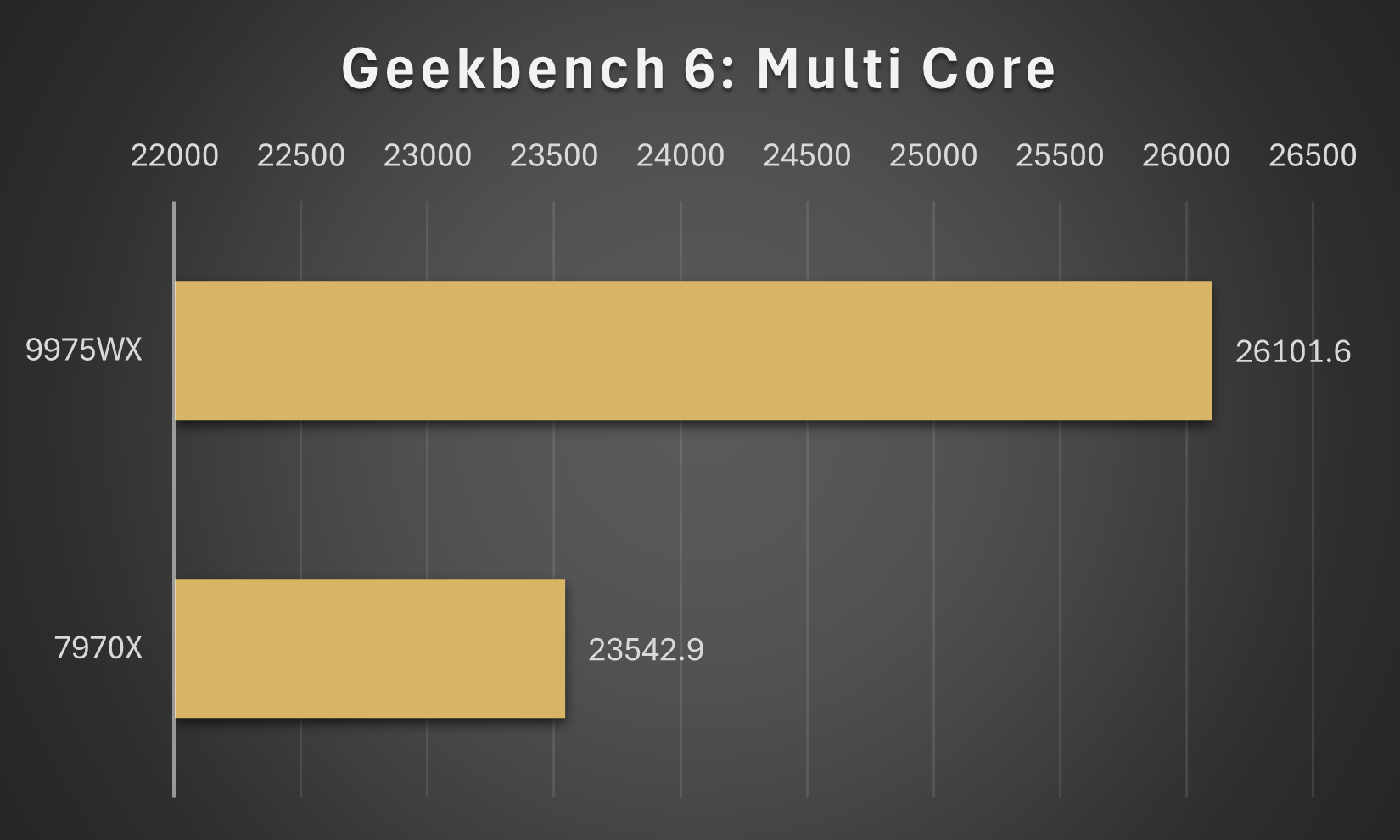
A 10.31% increase in Geekbench 6 multi-core performance shows a noticeable improvement in overall multi-threaded efficiency. For end users, this means tasks that leverage all cores (such as video editing, 3D rendering, large-scale simulations, and complex scientific calculations) will complete somewhat faster. While not revolutionary, the gain is enough to shave meaningful time off batch workloads or multi-step projects, helping professionals get more done in the same timeframe. For day-to-day light computing, the difference will be largely invisible, but for workloads that stress all cores simultaneously, the 9975WX provides a clear, measurable boost over the 7970X.
Code compilation performance
In our code compilation testing, the 9975WX achieved a time of 21:21.4654 vs a time of 22:22.7138 for the 7970X. A 4.67% improvement in Unreal Engine 5 source code compilation is a modest gain, translating to a compile time reduction of roughly one minute on a 22-minute build. For developers, this isn’t a dramatic change in day-to-day workflow, but over multiple builds or larger projects, it can slightly reduce waiting time and improve iteration speed. It’s the sort of incremental improvement that adds up in a professional environment, but highlights that for highly optimized, I/O-bound workloads like code compilation, the 9975WX offers only a small edge over the 7970X.
Conclusion
The AMD Threadripper™ 9975WX represents a thoughtful evolution of the 7970X rather than a radical leap. Across our testing, it consistently delivers modest to meaningful gains: 7–11% in rendering benchmarks like Blender, over 17% in V-Ray, and roughly 10% in multi-core Geekbench 6. These improvements translate to faster render times, slightly more efficient multi-threaded workflows, and incremental productivity gains for professionals handling complex 3D scenes, visual effects, or large-scale simulations.
That said, not all workloads benefit equally. Synthetic benchmarks like PassMark show only a 5.5% improvement, and tasks like UE5 source code compilation see modest, sub-5% gains. This reflects that the 9975WX’s advantages are most pronounced in applications that can leverage its full core count and the enhanced platform capabilities, particularly the expanded PCIe 5.0 lanes and slightly higher boost clocks.
In practical terms, the 9975WX is an excellent choice for studios, content creators, and engineers who need to maximize throughput in heavily threaded workloads or work with demanding I/O setups. For users whose tasks are less CPU-bound or already efficiently handled by the 7970X, the performance uplift may feel incremental rather than transformative. Ultimately, the 9975WX reinforces Threadripper’s position as a workstation powerhouse while offering tangible, if measured, advantages over its predecessor.
For those already on a 7970X, the upgrade is an incremental gain best justified by I/O demands and rendering-heavy workflows. For new buyers, the 9975WX is the clear choice.
If you’re considering upgrading from the 7000 to 9000 series Threadripper™ processors, our technical team can help you identify the best path forward for your specific workloads. Get in touch today on 0151 317 9860 or email [email protected]