
Punch Technology Ltd, a specialist custom PC builder, has been approached by a customer with a requirement to power an enormous eighteen, 27” monitors off of one workstation. The customer operates in the financial industry and has a requirement to track and view multiple data-sets simultaneously.
While multi-monitor PCs are nothing new for us here at Punch, powering eighteen monitors off of one system is not without its own unique challenges, namely;
GPU output limitations
Most readily available, consumer graphics cards will have 3-4 outputs (typically DisplayPort or HDMI). Even professional workstation GPUs like Nvidia Quadro or AMD Radeon Pro will only support 6 outputs per card. This means with one card, using HDMI, you could feasibly power between 3 and 6 monitors.
This would mean you have one HDMI cable per monitor, so if you have multiple graphics cards, you would quickly end up with an inelegant solution and a cable management headache.
Driver and OS constraints
Physically connecting 18 monitors is problem enough but it is further compounded by the fact that Windows, Linux and MacOS all have limits on how many displays they can recognise reliably.
Bandwidth and signal distribution
For each monitor you run off the one system, it is going to consume bandwidth depending on the monitor’s resolution and refresh rate, meaning there is an actual upper limit to the amount of monitors you can run off of one card.
Power, heat and form factor
Having multiple, high power GPUs in one workstation creates a requirement for strong cooling and airflow solutions to ensure that components continue to run at maximum efficiency.
Our solution
Consulting with our customer, our sales team quickly realised that the system wasn’t required to perform complex computations, but the requirement was purely for a system that could support the 18 monitors. The system will be set-up at a desk, and so keeping cables to a minimum was also important for keeping the customers workspace clutter-free.
Although the workload that the system will be used for isn’t particularly graphically demanding, the graphics cards need to be powerful enough to support the monitors without struggling with bandwidth or signal distribution.
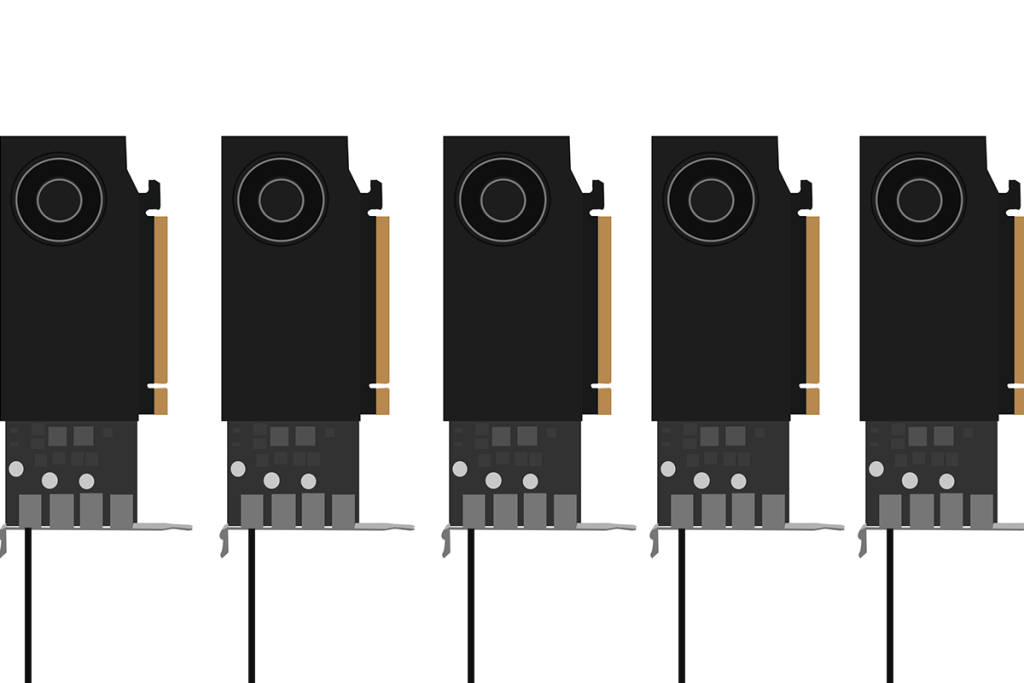
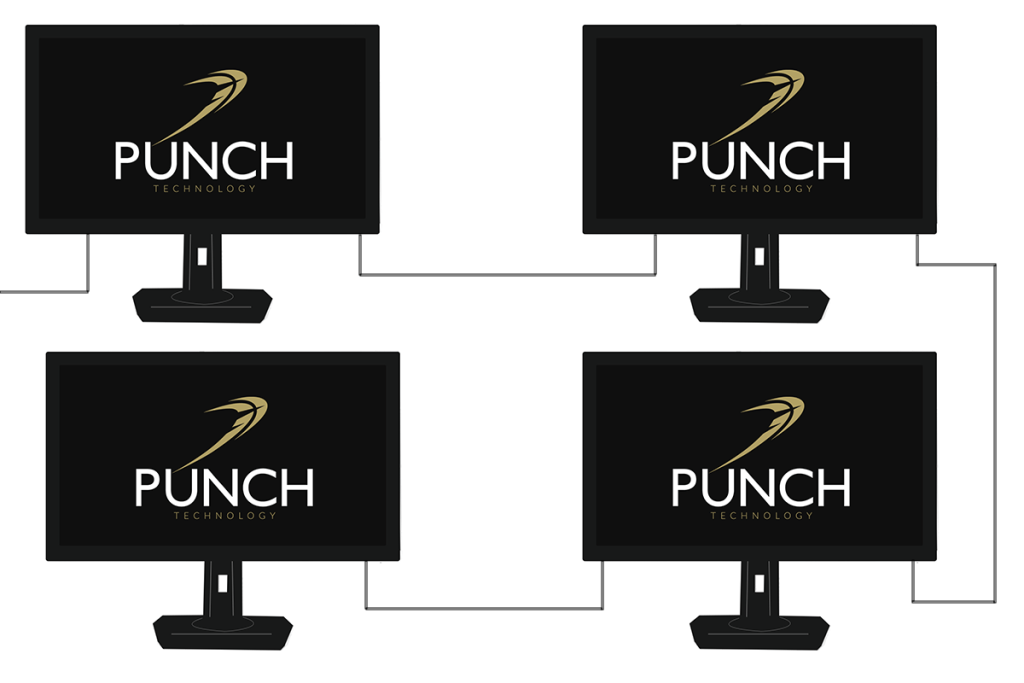
In the end, we opted to explore an MST (Multi-Stream Transport) monitor solution. MST monitors have a DisplayPort input and output, allowing us to daisy-chain 4 monitors off the back of one GPU. We chose a Threadripper CPU for its high PCIe lane count, which let us run five Quadro RTX A1000 GPUs at full PCIe 5.0 x16 speeds. This ensured maximum stability and bandwidth across all GPUs.
For our customer in the financial sector, this meant they could monitor all critical datasets simultaneously, without the mess of cables or the overhead of multiple machines. The result: a faster, more efficient workspace with reduced costs and greater reliability.
Our Technical Director, Sion Roberts says;
“When customers come to us with very specific requirements, it’s always our aim to deliver a solution that not only satisfies those requirements, but which does so in the most cost-effective and technically sound way possible.
With this project, we explored a number of solutions and eventually settled on a system that will efficiently handle the customers workload, both now and in the future, while minimising the clutter, cost, power-draw and other waste that less effective solutions would have created.”